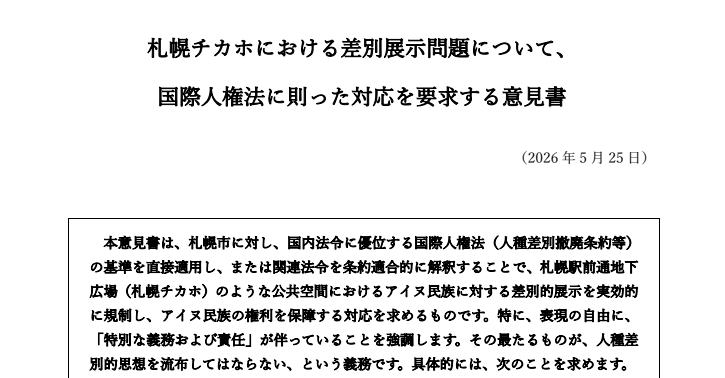
A group of Ainu and Wajin scholars issued a statement yesterday in opposition to an exhibition in the Sapporo Station Underground Plaza that was organized by the far-right lobbying group, Nippon Kaigi (of which Japan’s current Prime Minister, Takaichi Sanae, is a member). The exhibition spreads hate speech, harmful stereotypes, and incites racial discrimination against the Ainu people. The authors of the statement in opposition call for the city government to safeguard the rights of the Ainu people against racial discrimination as obligated under international human rights law. A translation of the statement’s summary is provided below. The full version of the original Japanese statement can be read here. [Statement updated by the authors on May 30, 2026].
A Statement Calling for Action in Accordance with International Human Rights Law on the Controversial, Discriminatory Exhibition at the Sapporo Station Underground Plaza.
Authors:
Osakada Yuko (Professor, Chuo University)
Kitahara Mokottunas (Professor, Hokkaido University)
Saito Tamitomo (Professor, Kwansei Gakuin University)
Nagai Fumiya (Lecturer, Kanda University of International Studies)
And one other (anonymous)
Summary: This statement calls on the City of Sapporo to effectively regulate discriminatory displays targeting the Ainu people in public spaces—such as the Sapporo Station Underground Plaza (Sapporo Underground)—and to safeguard the rights of the Ainu people by directly applying the standards of international human rights law (such as the International Convention on the Elimination of All Forms of Racial Discrimination), which takes precedence over domestic laws; or by interpreting relevant domestic laws in a manner consistent with the Convention. In particular, we emphasize that freedom of expression carries with it “special duties and responsibilities.” Foremost among these is the obligation not to disseminate ideas of racial discrimination. Specifically, we demand the following:
- Operate public facilities in a manner consistent with international human rights law, including in decisions regarding the granting of usage permits, with respect to exhibits that promote or incite discrimination against the Ainu people.
- Formulate clear operational guidelines that do not promote discrimination, based on Article 4 of the International Convention on the Elimination of All Forms of Racial Discrimination and Articles 4 and 5 of the Act on the Promotion of Measures for the Ainu People.
- Regarding the third-party body tasked with examining issues related to discriminatory exhibits, to ensure the Ainu people’s “free, prior, and informed consent” (FPIC), at least half of the committee members must be of Ainu descent. Furthermore, committee materials and minutes should, in principle, be made public to ensure transparency.