Edit 3rd September 2026: Fixed a couple inaccuracies (location of display, online image & information availability) Thank you to Dr. Reilly at the NMS for highlighting them to me!
The National Museum of Scotland, in Edinburgh, hosts one of the largest collections of both historical and contemporary Ainu items in the UK. These items come largely from Neil Gordon Munro’s personal collection in the early 20th Century; but also contains items from the late 19th century (from researchers Dr John and Grace Anderson and Isabella Bishop), and further items created specifically for the museum and/or donated by artisans throughout the 21st Century.
Found on Chambers Street, it is a quick five minute walk away from the University of Edinburgh’s Old Medical School, where Neil Gordon Munro (1863-1942) studied prior to his move to Nibutani (Biratori, Hokkaido). In Nibutani, he would go on to integrate himself with the local community and provide free healthcare, all whilst creating some of the earliest ethnographic writings on Ainu people and their culture by a western scholar. Whilst the largest collection of his items can be found in the National Museum of Scotland, other items in his collection can be found in other museums across the UK. In 2024, Ainu human remains brought to Scotland by Dr Munro and henceforth situated in the University of Edinburgh’s Anatomical Museum were repatriated to members of the Hokkaido Ainu Association, and are currently being stored in Shiraoi within the Upopoy ossuary.
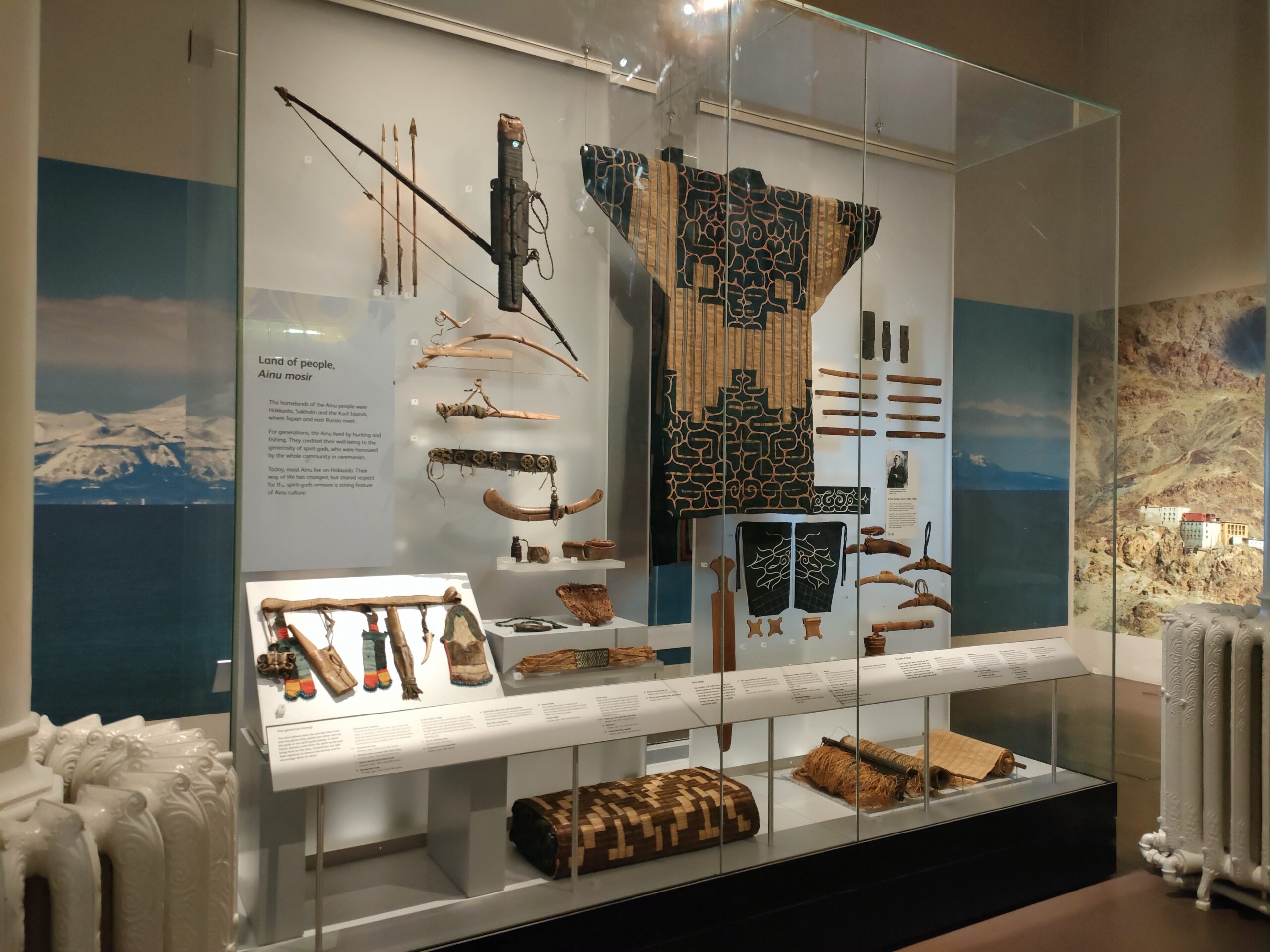
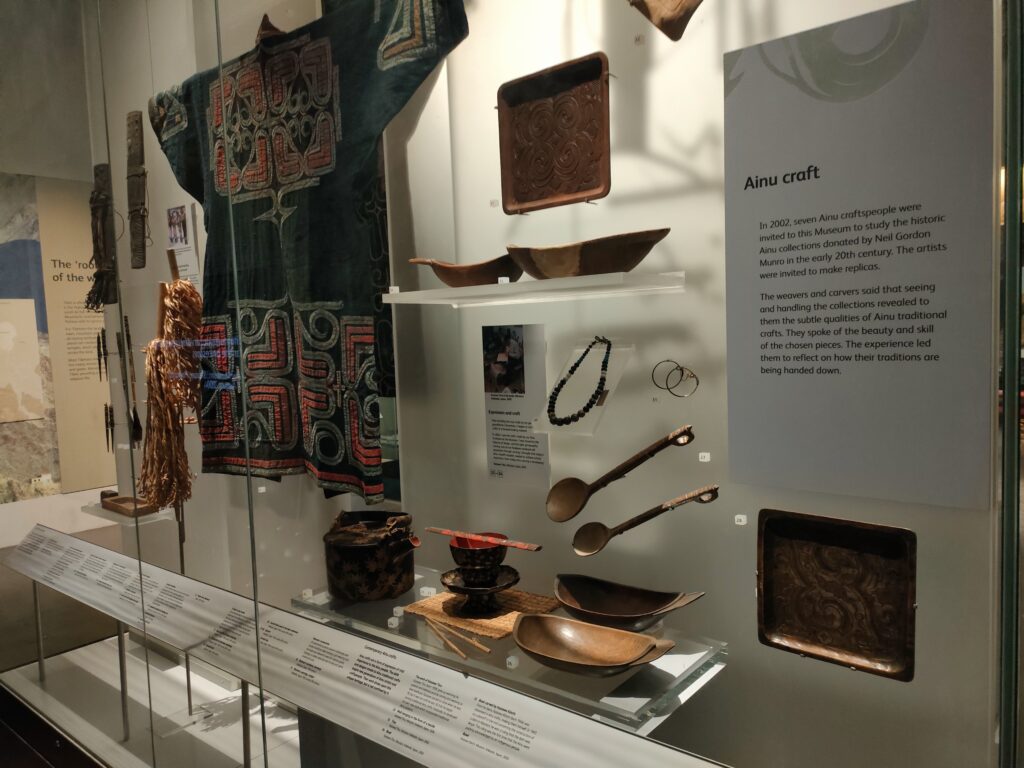
According to the National Museum of Scotland’s website, 88 items are currently on public display. The display is found on Level 1, in the Living Lands gallery just off the Grand Gallery. Amongst the public items are an attus (a robe made from the woven elm tree barkcloth, from which it shares it’s name,) and a ruunpe (a robe made from cotton). In 2002, a handful of Ainu artisans visited the museum to study the collection, and subsequently donated some works made specifically for the museum. These include works by Kaizawa Toru and Kaizawa Mamoru, woodworkers hailing from Nibutani who are known for their intricate ita (decorative tray) creations. Further embroidered leg wraps by Tomakomai mother and daughter duo Sumazawa Yoeko and Sumazawa Yumiko are also on display.
An additional element of the public display is a looping three-and-a-half minute video from 2003 showing a kamuy-nomi taking place at the old Ainu Museum in Shiraoi, where the current Upopoy National Ainu Museum and Park now stands. Away from this main display, a tonkori (zither) is on display in the Performance and Lives gallery on Level 3.
Including items not on public display, the National Museum of Scotland boasts a total collection of 368 items as of writing. These include embroidered COVID-era facemasks made by the Noboribetsu Ashiri Association, ceremonial swords, and makiri (knives). Various items used in the creation of robes such as looms and nu-it-saep (thread winders) are also held in the museum’s archives. Much of the museum’s Ainu object collection has not been photographed online, however, the aforementioned nu-it-saep and several other weaving-related objects such as looms and backstraps do have images available. I would recommend checking the website for a more substantial overview of their behind-the-scenes collection, including all available photography. Additional information on attus is featured in their article on barkcloth across the world.
Having visited a good handful of Ainu collections in museums both in the UK and Japan, a strength of this collection’s presentation is the wording found throughout the display. The notes are largely in present tense, and several points emphasise the ongoing change and fluidity which is perpetual in modern, thriving cultures. For example, one note discusses the increasing frequency of animal symbolism in Ainu craftwork through time. There is nothing to suggest that Ainu culture is something frozen in time and now only exists in history, which is a misconception many museums – whether consciously or unconsciously – often find themselves perpetuating.